
One of the first questions a prospective buyer for your healthcare business will ask is deceptively simple: "Are you a C corporation or an S corporation?" It's typically asked by buyers early on in an engagement, and how you answer can change everything about how the deal unfolds.
Most owners don't realize how significant this question is until they're already in discussions with a buyer. By that point, the structure of the company is no longer a technicality. Rather, it directly affects how the deal can be structured and how much money you will keep at closing.
While most small and mid-sized healthcare companies are S corps, a surprising number still operate as legacy C corps. And when a C corp goes to market, the seller almost immediately runs into a familiar problem: Buyers generally don't want to buy a C corp.
Why Healthcare Buyers Don't Want C Corps
From a buyer's perspective, purchasing an S corp or limited liability company (LLC) is straightforward. Purchasing a C corp is not.
The biggest issue here is double taxation. A C corp pays tax when it sells its assets, and then its shareholders pay tax again when the corporation distributes the proceeds. In healthcare, where buyers overwhelmingly prefer asset deals to avoid assuming regulatory and compliance liabilities, this double tax becomes nearly unavoidable.
On top of that, buyers want the future tax benefits that come with purchasing assets. They want to "step up" the basis and depreciate or amortize what they acquire. They also want to avoid inheriting past compliance problems, billing issues, employment liability, or anything else that might be lurking beneath a company's surface. A stock purchase doesn't give them that protection. An asset purchase does.
The problem is that, in an asset sale of a C corp, the tax burden lands squarely on the seller, not the buyer. And that tax burden is significant enough to derail or at least materially reshape a transaction.
In short: What buyers prefer structurally is often the opposite of what gives a C corp seller the best outcome.
Why Converting to an S Corp at the Eleventh Hour Doesn't Work
This is the part that catches many healthcare business owners off guard.
When faced with buyer pushback around the C corp structure, owners often assume they can simply convert to an S corp before the transaction closes and eliminate the double tax. Unfortunately, the IRS prevents this by imposing what's known as the built-in gains (BIG) recognition period.
Historically, this period was 10 years, but a 2015 change in tax law reduced it to five years. Of course, even five years is generally far too long for a seller who is already in negotiations with a buyer. If you convert from C to S immediately before a sale, the IRS will still tax much of the gain at the corporate level as if you were still a C corp.
In other words, converting after you've already agreed to sell doesn't fix the problem. You're still treated like a C corp for tax purposes on that sale.
This is why I tell owners that if you wait until you're talking to a buyer to look at your corporate structure, you've unfortunately waited too long.
What You Can Do If Your Business Is Already a C Corp
If your company is still a C corp at the time you begin speaking with buyers, you may not have the full range of planning options, but you are not without tools to consider.
- Section 338(g). A buyer can elect this unilaterally — no agreement from you as the seller required. It lets the buyer treat the stock purchase as an asset purchase for tax purposes, giving them the basis step-up they want. The tradeoff for you: It doesn't eliminate your double tax. The target still pays corporate-level tax on the deemed asset sale, and you're taxed again on the proceeds, so this election mainly serves the buyer's interest, not yours, unless it's paired with a higher purchase price to offset the extra cost to you.
- Section 338(h)(10). This one only applies if your company is an S corp or a subsidiary within a consolidated or 80%-owned group. A standalone C corp doesn't qualify, so this may not be on the table for you at all. Where it is available, it works differently than 338(g) in a way that matters: It requires both you and the buyer to agree, and it avoids the second layer of tax that 338(g) leaves in place. That's why it's generally the more favorable outcome for sellers, when the structure allows it.
- Personal goodwill. Another tool — and one that has been effective in many healthcare transactions — is the use of personal goodwill. If part of the company's value lies in the owner's personal relationships, reputation, or expertise, and if those intangibles were never transferred to the corporation through an employment contract or other agreement, the owner may be able to sell that goodwill personally. This portion of the sale would be taxed at capital gains rates and, importantly, would not be subject to corporate-level tax. The IRS examines these situations closely, so documentation must be handled carefully, but when appropriate, personal goodwill can meaningfully reduce a seller's tax burden.
- Section 1202 (Qualified Small Business Stock (QSBS)). If your company's stock was issued directly to you by the corporation — not acquired secondhand — it may already qualify as QSBS, which allows shareholders to exclude a significant portion of capital gains from federal tax entirely. The One Big Beautiful Bill Act (OBBBA), signed into law in July 2025, expanded this benefit for stock acquired after that date: The required holding period dropped from five years to a tiered schedule (50% exclusion at three years, 75% at four, 100% at five), and the per-issuer exclusion cap rose from $10 million to $15 million. The catch for many healthcare businesses: The tax code excludes companies that primarily perform "health services" from qualifying, a category that has historically swept in physician practices and similar direct-care businesses. Whether your business clears that bar is a fact-specific question that requires a tax advisor's review, but if it does, QSBS can be one of the most powerful tools available, and unlike converting to an S corp, it doesn't require restructuring at the last minute.
Even with these strategies available, none of them is as clean or predictable as simply operating as an S corp well before a sale.
When to Convert Your Business to an S Corp
Converting from a C corp to an S corp can absolutely be the right move for a healthcare business owner, but only if it's done early enough. If you convert and let the built-in gains recognition period expire, you enter a much more favorable world when it comes time to sell. Gains flow through to shareholders directly, and the transaction can be structured in a way that's far more attractive to both parties.
The key is lead time. Ideally, owners should begin evaluating their corporate structure three to five years before they plan to go to market. That window provides the flexibility to convert, plan around the BIG recognition period, explore reorganizations if needed, and make sure you're positioned for the most tax-efficient outcome possible.
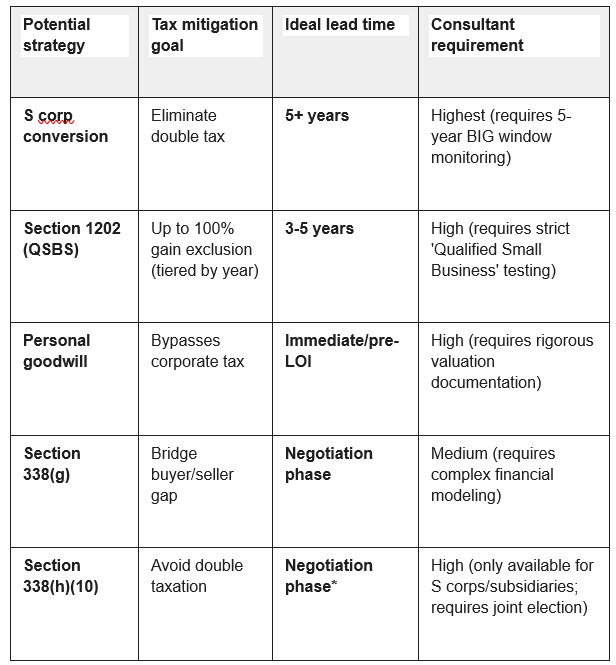
* Only available for S corps or corporate subsidiaries, not standalone C corps. See Section 338(g) above for the standalone-C-corp alternative.
These decisions are highly dependent on your company's financial profile, its appreciation history, its shareholder base, and the likely form of a transaction, which is why they call for expert guidance from the start. A knowledgeable mergers and acquisitions tax attorney, working alongside an experienced healthcare M&A advisory firm (like VERTESS), can help you run the models, compare the scenarios, and chart a path that preserves as much of your proceeds as possible.
If You're a Healthcare Owner, the Right Time to Look at This Is Right Now
One of the most avoidable frustrations I see in healthcare M&A is a seller discovering too late that their structure is working against them. By the time a buyer is requesting diligence items, the seller has little room to maneuver. That's when financial outcomes get compromised.
If you're even thinking about selling in the next few years, this is the time to review:
- your corporate structure,
- the potential tax implications of a sale,
- whether a conversion makes sense, and
- how buyers in your sector are likely to approach your entity type.
These decisions can easily shift the economics of your sale by a lot of money.
Thinking About a Sale? VERTESS Can Help You Understand Your Options.
If you're preparing for a future exit for your healthcare company, or even just testing the waters, I can help you understand where your current structure helps you and where it may hold you back. I work with healthcare business owners to evaluate their options, identify tax and structural issues before buyers do, and put them in the strongest position possible when the time comes to sell. If you would like clarity on your situation and guidance on the best next steps, don't hesitate to reach out. I'm always happy to talk.
About the Author
Alan J. Hymowitz, CM&AA, has spent more than a decade facilitating numerous diverse M&A transactions in the pharmacy marketplace across the country. He was previously a “hands on” owner and manager in the pharmacy and home infusion healthcare marketplace for over 15 years, and successfully sold his pharmacy to a national company. He holds URAC Accreditation, Specialty Pharmacy Consultant designations, a Bachelor of Arts from Rutgers University and a Master of Arts from the John Jay College of Criminal Justice.